Today, we are going to delve deep into how much the 1963 $5 dollar bill is worth today, considering the factors that can potentially make these 60-year-old bills more valuable, such as the condition of the eye-catching green or red seal.

All of these were printed by the Bureau of Engraving and Printing in the same year and began to circulate among the general public. There are three variants of $5 bills from 1963, including one featuring a red seal and two with a green seal.
The obverse of the bill depicts the portrait of Abraham Lincoln, the 16th president of the United States of America. You will see the seal of the United States Treasury on the right side of the bill, either green or red. Additionally, you will find the number “5” on each corner of the bill. At the bottom, the bill is also written as “Five Dollars”.
You will find the signatures of the Treasurer and Treasury Secretary at the bottom area of the bill. The numbers should be identical on both sides. In the upper-right and lower-left corners of the bill, you will see a unique serial number.
Before 1963, the words “Will pay to the bearer on demand” were used on the obverse, but it was removed for the first time that year.
The first year this phrase was added to the five-dollar banknote was 1963. On the reverse side of the Lincoln Memorial, it shows the motto “In God We Trust” written above it. Meanwhile,
1963 $5 Dollar Bill Values and Varieties Guides
1963 $5 Dollar Bill Value (Red Seal)

The most valuable of the three printed types by the Bureau of Engraving and Printing in the year 1963 is a $5 bill with a red seal.
A portion of the nation’s overall debt consisted of currency featuring a crimson seal. To put it succinctly, the Department of the Treasury bore a direct responsibility to exchange that banknote for silver or gold, signifying that the seal was present on currency produced by the United States government between the years 1862 and 1971.
The last series of the five-dollar bill, famously known as the bill with a red seal, was more special as it made runs in 1963. They were removed from circulation in the 1960s. These legal tender notes are no longer redeemable by the US government today.
As red seal 1963 five-dollar bills are no longer in circulation, they possess greater worth as collectibles in comparison to their green seal counterparts.
If you can find it, you may be able to sell a 1963 $5 bill with a red seal for $6 in good condition. Additionally, you could potentially sell a dollar bill with a red seal and a face value of more than $25 in uncirculated MS63 condition.
Another factor that could raise prices for a $5 dollar bill from 1963, is the creation of Bureau of Engraving and Printing notes that replace the serial number with a red seal star.
Could you sell a red seal one for $25 to $90? These notes are rare and can boost the price of any $5 bill from 1963. You can tell if a bill is a star note by checking if there is a star before its serial number.
1963 $5 Dollar Bill Value (Green Seal)

There are currently abundant banks that issue high-value banknotes, which are not greatly valued by circulation. One example is the $5 dollar bill from 1963, which has a green seal. These banknotes, also known as Federal Reserve Notes, are commonly used by US citizens. Let’s delve into the topic of moving these notes to the Federal Reserve.
Presently in circulation, it remains a banknote, which is not unfavorable given that you could potentially trade it for approximately $10 to $20 if you come across one in pristine condition without numerous flaws and creases. The sole expense of a 1963 $5 bill with a green seal is its nominal value of $5.
The price for the 1963 $5 dollar bill with a green seal and a serial number with stars also raises the price. Star notes are valued at $25, instead of $40.
Shortly, we will discuss the 1963A five-dollar note, which possesses a slight degree of scarcity in contrast to the bills that were not issued by the Richmond and Minneapolis banks. During the year 1963, this particular bill was issued by ten out of the twelve federal reserve banks.
1963A $5 Dollar Bill Value (Green Seal)
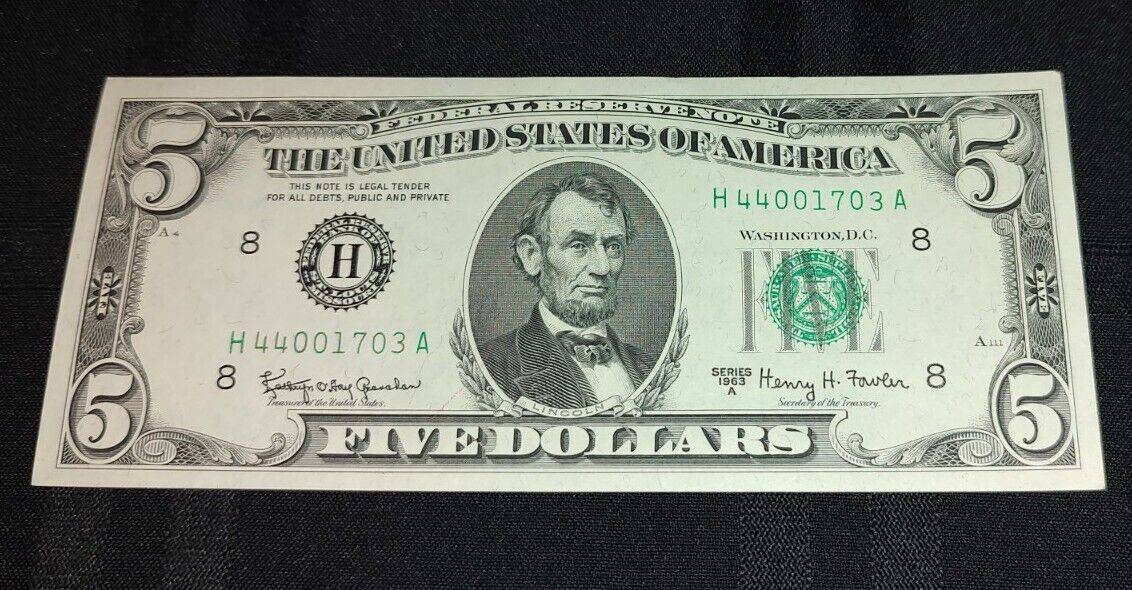
Even though they bear the same denomination, reverse, and obverse, the identical green seal gives the impression that the previous note is nearly indistinguishable from the 1963A five-dollar bill if not examined closely.
So, it should come as no surprise that the value of these two five-dollar bills from 1963 are the same as well.
For each type, uncirculated and star note currency, you can receive amounts of $20 and $40, respectively. The face value of these bills is $5, meaning that a 1963A five-dollar note in good condition would be worth that much.
Nevertheless, there exist two primary distinctions between the 1963 and 1963A editions of five-dollar bills.
The first difference is that instead of being signed by Secretary Dillon, the 1963A bills were signed by Secretary Fowler.
Took part in the production of the 1963A five-dollar note across all 12 federal reserve banks. The fact that it is not as scarce as the 1963 bill produced by just 10 banks suggests the second and more notable distinction.
However, the 1963A bills are generally more economical compared to the 1963 edition of the five-dollar bill, albeit only marginally.
History of the 1963 $5 Dollar Bill
In 1863, President Lincoln signed the National Currency Act, which paved the way for a uniform national currency, making it possible to circulate banknotes that were no longer in print for the US dollar.
The inscription next to the Statue of Freedom was composed by Alexander Hamilton, the inaugural Secretary of the Treasury of the nation. Interestingly, it was not Abraham Lincoln who appeared on the first-ever five-dollar bill, which is quite amusing.
It wasn’t until 1914 that Lincoln, who played a crucial role in modernizing the US economy, abolishing slavery, and leading the country during the Civil War, was commemorated on the $5 bill.
In 1963, the government exchanged two federal reserve notes and one legal note for gold or silver, resulting in the introduction of three different variations of the five-dollar bill. This event marked the beginning of the five-dollar bill as we are familiar with it today, and it has remained in circulation ever since.
Although the design of the bill would change every few decades, one thing stayed the same–it always honored the great Abe Lincoln.
1963 $5 Dollar Bill Grading
The higher the quality and condition of your bill, the better its value will be. Today, the grading quality is what determines the true value of a 1963 $5 bill, with the type of seal and the face value being less important.
Here are several techniques the PCGS could employ to assess a 1963 $5 currency bill, considering its state and paper grade:
Watch this video for additional suggestions on how to evaluate your currency notes.
1963 $5 Dollar Bill Value Chart
The value of the 1963 $5 bill with a green seal ranges from $25 to $40, while the value of the 1963 $5 bill with a red seal ranges from $20 to $10. Additionally, the value of the 1963 $5 bill with a green seal in MS63 condition is $90, while the value of the 1963 $5 bill in fine condition ranges from $25 to $15. The circulated 1963 $5 bill is worth around $13.50, while the uncirculated bill is valued at $6. The 1963 $5 bill with stars and notes is considered to be in very good condition, and its value is determined by its mint mark.
1963 $5 Dollar Bill Errors
1. 1963 $5 Dollar Bill Dual Denomination Error
The printing mistake of having two different denominations is frequently observed in five-dollar bills. On the backside, you will notice a different value, for instance, a $10 bill, whereas on the front, it might display a design typical of a $5 bill.
Be cautious, as a similar occurrence can be discovered on a 1963 $5 banknote. In the year 2020, this banknote was sold at an auction for a whopping $25,000! An identified occurrence of this mistake was observed on a five-dollar banknote produced in 1934.
2. 1963 $5 Dollar Bill Mismatched Serial Number Error
Sometimes, a mechanical error can occur where the serial numbers on the five-dollar bill in the lower left-hand corner and upper-right corner don’t match exactly.
A message of this nature can be sold for a large sum of money.
3. 1963 $5 Dollar Bill Ink Smear Error
One of the more striking mistakes when printing dollar bills is the ink smudge error. The ink employed to print the pattern on the front or back gets blurred or smudged during this occurrence. The ink nozzles at the Bureau of Engraving & Printing become stuck or malfunction.
One way to determine if a five-dollar bill has a valid red rejection mark on its left side is by observing a genuine five-dollar bill with ink smears.
Explore the appearance of various common errors on the five-dollar bill by watching this video by Old Money Prices.
1963 $5 Dollar Bill Value FAQs
How much is a $5 bill worth with a red seal?
The three series, specifically Series 1928, 1953, and 1963, were produced with a red seal on the five-dollar bill. Particularly for a circulated bill that is in average, good, or fine condition, the worth of a five-dollar bill with a red seal remains fairly consistent with its original value across all three series.
The value today would be significantly greater if the banknotes were in excellent condition; it could potentially increase from $40 to $50 dollars. The $5 bills with crimson seals were never used and remained in flawless state. However.
How much is an old $5 dollar bill worth?
Honestly, in today’s time, that large sum of money will have little value, equivalent to a five-dollar banknote. The cost of $5 might remain unchanged from its initial printing.
If you happen to come across an uncirculated or uniquely misprinted five-dollar bill, you could potentially sell it for a significantly higher price, possibly exceeding $50. However, this is dependent on your luck.
How can you tell if a 5 dollar bill is worth money?
Collecting uncirculated bills is usually worth it as they often have creases and folds without any condition issues. If you come across a $5 bill from 1963 or similar years that is uncirculated, you can expect it to be worth more than its face value.
A five-dollar banknote may also be valuable if it contains mistakes that make it uncommon and difficult to come across.