Nobody picks up a book about trauma because they are feeling well. However, when I found myself feeling a little down last week and unable to break out of the funk, I picked up a copy of “What Happened to You? Conversations on Trauma, Resilience, and Healing” by Oprah Winfrey and Dr. Bruce D. Perry. I didn’t want to be disappointed and, well, it’s Oprah. Since I learned that Oprah Winfrey had a new book out, I went back and forth about whether I should read it.
I was not let down.
Conversations take unexpected and often rejuvenating turns as Oprah Winfrey and Bruce D. Perry engage in “What Happened to You? Conversations on Trauma, Resilience, and Healing.” They possess a unique and exceptional ability to engage in difficult, sincere, and compassionate discussions with individuals from all walks of life, including those who may not initially show empathy, and uncover their intrinsic human nature. Oprah can captivate an audience, even someone unfamiliar.
The book focuses particularly on how development affects upbringing, providing an accessible explanation of what trauma does to the brain. It can be difficult for readers of “What Happened to You?” To follow along, but with Oprah as their guide, they will find that doctors sometimes struggle to explain the effects of trauma on the brain.
The book “What Happened to You” by Perry Dr. Winfrey offers a fascinating introduction to trauma theory, discussing the immense power of healing and the significance of trauma in culture and community. It steps aside from traditional therapeutic frameworks and talks frankly about simple things like meaning and the therapeutic aspects of power. While the book doesn’t offer anything else you can learn elsewhere, it does provide an accessible introduction to trauma theory, as concerned with the most important aspects of the book. Having spent years listening to lectures on trauma, attachment theory, and Buddhist perspectives on trauma, and having read more in-depth books on trauma like “The Body Keeps the Score,” I can’t find anything else that can offer what this book does.
For example, Dr. Perry notes that in traditional cultures, there were four pillars of healing: the use of natural plants and hallucinogens to bring about healing, adherence to a set of values or beliefs that brought meaning, rhythmic singing and drumming, and a connection to the natural world and community.
I have always felt like an outsider, never really being part of a community. However, I have always had close friends. I have always struggled with a sense of belonging. I have just started to put down roots and live in Hawai’i. I kept returning to the idea that true and full healing cannot take place in the absence of connection or community. As I read Winfrey Perry Dr.’S work, I felt a bit sad but couldn’t help feeling that I couldn’t find the solution.
As the globe entered a state of lockdown, I delved into literature that depicted the pre-western contact era in Hawai’i.
Medicine Herbal Hawaiian of Practice and Secrets “The book stunning her in vividly describes Gutmanis June as, within ruptures the well as people between ruptures the fixing without, healing relational without place take not could healing, lapa’au la’au the In community. Her or his to person whole the also but body, sick the only not treated medicine plant of form holistic a, lapa’au la’au the in used were plants and herbs healing And beings. All of interconnectedness the in belief and awe, wonder of sense deep a reflected gods of pantheon The singing. And dance, poetry through gods its and nature to connection their expressed who people the dances and chants the oli, and hula the in down passed framework mythological and natural vibrant the in also is It generations. For islands the on families sustained that traditions farming community-based rich the in reflected is This world. Natural the of stewards good were communities farming close-knit Polynesian. You” to Happened What ” in describes Perry Dr. Healing traditional of pillars four the with rich lives lived contact, to prior Hawai’i in who people or Maoli, KanakaOutput: The book stunningly depicts Gutmanis June as a vivid portrayal of the Hawaiian herbal medicine practice and its secrets. It highlights the interconnectedness between people and the healing power of lapa’au la’au, a holistic form of plant medicine that not only treats the body but also heals the person as a whole. The book also explores the deep sense of belief, awe, and wonder that the Hawaiian community has towards the pantheon of gods, expressing their connection to nature through singing, dancing, poetry, and chants. These cultural traditions, passed down through generations, reflect the vibrant mythological and natural framework of the Hawaiian islands. The close-knit farming communities in Hawai’i were skilled stewards of the natural world, sustaining rich community-based traditions. “What happened to you?” Perry Dr. Describes the four pillars of traditional healing and the rich lives lived by the Kanaka Maoli people in Hawai’i prior to contact.
In the midst of Manoa, the ancient knowledge emerges sporadically, similar to the mountains concealing and reemerging. Frequently appearing in disguised symbolism is the age-old healing power of the community, of the flora, of water. Particularly during eruptions, Pele’s name is widely mentioned, although the true essence of the deities is concealed. Perhaps only resembling the ancient form in essence, you will discover a commercialized westernized hula. Violence, colonialism, homelessness, addiction, and abuse, neighborhoods torn apart by now exist. From the land to the sea, there now exist interconnected farming communities that exchanged ideas and food, where rhythmic dances were based on ancient chants and profound spiritual customs. The ancient Polynesian traditions, which people initially brought to these islands, contrast starkly with the relational poverty of Modern Hawai’i.
Like a poem, my walking pace had a soothing effect, similar to the healing power of dancing. While taking a long walk, I became aware of the rhythmic movement of my feet and its potential to heal. However, I had no intention of attempting a solo drumming session in Waikiki, and although I lived close to the sea, I realized that I would have to settle for the accessible options on Dr. Perry’s list: nature and rhythm. Since I had no access to hallucinogens or shamans, and my beliefs were still uncertain, I could only prioritize being busy for a limited time. The reasons behind this were both predictable and puzzling to me. With growing conflicts among my closest friends and family members, and with no significant community center available (especially due to the impact of the COVID-19 pandemic on communal spaces), I felt a sense of loss.
I discovered myself surrounded by gloomy thoughts, resembling vultures circling above. Depression brings the walls closer. As I delve deeper into my own limited inner world, I feel increasingly lost and unable to motivate myself even for the simplest tasks. Recently, I have found myself sleeping in the middle of the day, unable to complete even the most basic of chores. I can go for days without noticing, but eventually, the subtle and gradual onset of depression settles into my very bones.
I attached a leash to my dog, and started walking.
There is no humanity to mention in a deserted street when you’re walking through it during Covid-19, but the sentiment “humanity” falls short. But the same old arguments circled around me over and over again. Instead of being better than Yeats’s sad falcon turning in a widening gyre, my thoughts during the first half of my walk were no better. Unlike a rhythmic movement, the effects of the pill were slow and cumulative, but I wish the system could report an instantaneous change in my wish.
Waikiki has two distinct qualities in the summer, one being dry and the other being wet. Summer would be arriving soon here. Thanks to the loosening of pandemic restrictions in the past few weeks, life has recently started to come back to the Hawaiian Royal. The newly lit flames of the Hawaiian Royal mirror the clouds above them, and the sun has now settled behind the mountains, weeks ago it had stopped setting over the sea during the winter. As I continued my walk, I slowly found my thoughts widening at Ka’ena Point. It wasn’t until I reached the sea that I settled into a deeper feeling of peace inside me.
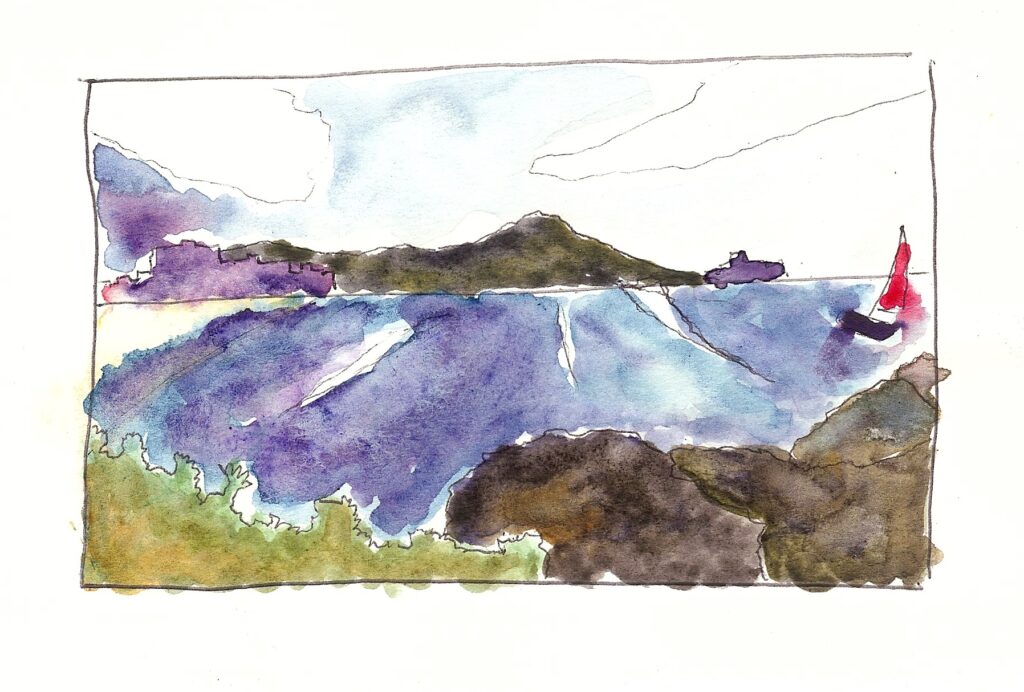
I was guided to Café Beach, where I sniffed the palm trees and walked barefoot. I didn’t feel isolated but instead, my mind widened and my heart opened. On the beach, I saw people reading books and young people lounging on hammocks. There were retirees snorkeling and children wading, while stand-up paddleboarders and welcoming lifeguards offered a calm water respite. The weekend was promised to have a rising swell, but unfortunately, the surf was down. In the park, two boys playfully sang falsetto and played the ukulele on a bench.
According to Dr. Perry in “What Happened to You,” the medical approach to dealing with trauma, depression, and anxiety, namely psychopharmacology and cognitive behavioral therapies, places a significant emphasis on and fails to recognize the true importance of connectedness and rhythm.
In this island of O’ahu, there are countless opportunities to gain wisdom through the diverse range of natural experiences. Instead of surfing the peaceful and rhythmic waves, I can choose to engage in a meaningful conversation with a friend, jotting down my own thoughts in my personal notebook. I strongly believe that there is an infinite amount of reality to explore, and I have found these thoughts to be helpful. Additionally, during times of great distress, I have been a patient of cognitive behavioral therapies.
Reading also provides a type of community, albeit remote.
Opening up the conversation and interview with Oprah, the hospice brochure teaches her the right words to say, and she writes about being unable to find the right words when visiting her frozen mother in hospice. She opens up about the ways her mother has shaped and challenged her throughout life, and shares some of the most moving parts of her own traumatic upbringing.
Ultimately, Oprah discovers her path ahead, but the journey is exquisitely unforeseen and deeply touched my emotions.