Thanks to the Affordable Care Act (ACA), millions of individuals are now able to access affordable health insurance. With this emergency health care in place, you no longer have to wait for long periods of time or rely on community clinics for your everyday health needs. You can also receive regular dental and medical care to ensure you stay healthy. Health insurance is one of the best ways to protect yourself and your family in case of illness or medical emergencies.
If you opt not to purchase health insurance, you might be required to pay an additional amount on your taxes as a consequence. Furthermore, the Affordable Care Act mandates that every individual residing in the United States must possess health insurance.
Get the PDF Brochure here:
EnglishSpanishFrenchArabicAmharicChineseVietnamese.
What has changed in Health Insurance
The Affordable Care Act altered the functioning of health insurance. A few of the modifications include:
What is Health Insurance?
The health insurance company with which you have signed a contract requires you to pay for some of your health care costs.
When you go to the physician, you will still be obligated to cover certain expenses, such as your monthly fees and your copayments. However, this does not imply that they will cover all expenses.
When you’re unwell or to maintain good health, whether that entails regular examinations, you can visit the physician with medical coverage.
Now you have the option to purchase health insurance via the Health Insurance Marketplace.
The Insurance Marketplace (also known as Health Exchanges in certain states) is a novel approach to assist you in discovering and purchasing insurance. It encompasses a broader range of medical requirements, including visits to your healthcare provider, in order to support your well-being.
Depending on what medical care you need, you might also qualify for tax credits from the government to help make your health insurance even less expensive. Insurance may be more affordable with different plans, so you’ll need to think about what you require.
Having health insurance allows you to receive faster and superior care, which ultimately helps you stay healthier. You don’t have to wait for long periods or go to overcrowded community clinics for medical care if you have health insurance. People who have health insurance can afford regular check-ups, so they don’t have to turn little health issues into big problems. Health insurance enables individuals to take better care of their health.
Types of Health Insurance Plans
HMO (Health Maintenace Organization) and EPO (Exclusive Provider Organization)
If you want to use a different hospital or doctor, you will have to pay for it yourself, as they are not included in the network of your insurance plan’s coverage.
EPOs typically do not require a referral, whereas HMOs typically require you to obtain a referral from your primary physician in order to consult with a specialist such as an endocrinologist or therapist.
PPO (Preferred Provider Organization) and POS (Point-of-Service Plan)
It will cost you less if you select ones that are included in the network of the insurance plan. You have the flexibility to choose any doctor or hospital with these plans.
If you have a POS plan, you can visit any doctor within the plan without needing a referral. However, if you have PPO plans, you can visit a doctor without getting a referral.
HDHP (High Deductible Health Plan)
In contrast to having high deductibles and low premiums, HDHPs are often considered as alternative options. With an HDHP, you can use a health savings account or a health reimbursement arrangement to pay for some medical costs. This means that your employer deducts some money from your paycheck and puts it into a special savings account. You can then use the funds from that account when you need money for medical care.
Catastrophic Plan
Although the deductibles are high, the monthly premiums remain affordable. This plan primarily provides coverage for substantial medical expenses resulting from car accidents, such as major injuries. It is designed to protect individuals from extremely expensive medical costs. Individuals under the age of 30 or those with hardship exemptions may consider purchasing a “catastrophic” plan.
Essential Health Benefits
The health insurance plans now provide you with at least these essential benefits. It is well-known that the following health benefits are offered by all health insurance plans, which also ensures that the ACA guarantees these benefits.
How Out-of-Pocket Maximums Work
The illustration provided below can assist you in gaining a clearer comprehension. Once you attain the utmost threshold, you are no longer required to make payments for that portion of the expenses. Every insurance scheme includes a maximum out-of-pocket limit: a cap on the amount you must spend on healthcare within a year.
 |
Before First Expense At the beginning of the year, John has spent zero towards his $1,000 out-of-pocket maximum. First Medical Visit John must pay $100 for x-rays. Second Medical Visit John pays a $20 copay. Third Medical Visit John gets blood taken for tests and pays $125. Fourth Medical Visit John has an emergency and pays $275 at the ER. Fifth Medical Visit John is admitted to the hospital. His bills total over $10,000, but he only pays $480 of it because he has reached his $1,000 out-of-pocket maximum. |
Networks
Your health insurance company forms a network known as “a group” that collaborates with a collective of doctors, hospitals, pharmacies, and laboratories. These entities may be located within one region of your state or in neighboring states, and they have established a mutual agreement regarding their pricing.
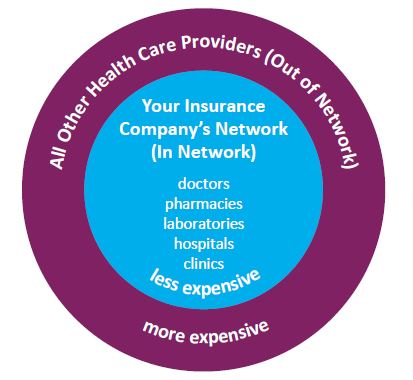
Prior to selecting the insurance plan, it is important to verify whether they are affiliated with a health insurance company’s network, especially if you have a preferred doctor, hospital, or medical provider. If you require healthcare services outside of this network, you may be responsible for covering the costs independently. Consequently, it is advisable to consult healthcare providers who are included in the network of your chosen insurance company.
The next page provides more information about different types of health insurance plans available. If you have insurance, your doctor will check if it is in-network, but some insurance plans will allow you to see an out-of-network provider by paying more for the appointment.
Deductibles and Co-insurance
Before starting a company, you must pay a certain amount of money as insurance. Some insurance plans have a deductible.
When you have a high deductible for your health insurance, your monthly insurance bill (premium) is often smaller. Some people choose a high deductible if they think they will not need a lot of medical care, as they may have to pay a larger part of the costs for their health care before their insurance company will pay.
Depending on your insurance plan, you may have to pay a percentage or a fixed amount as co-insurance for your health care costs. For example, if your insurance covers 80% of the cost of an x-ray, you will only need to pay $20. Some people may choose to pay a higher monthly premium in order to have lower co-insurance or no co-insurance costs at all.
Preventive Care
Preventive care means taking measures to help you maintain good health. These services help prevent you from getting sick or assist in preventing illnesses. It’s also beneficial for your overall enjoyment of life and better health. No one wants to become sick.
Due to this, the Affordable Care Act (ACA) has a regulation that mandates health insurance to always incorporate complimentary preventive care.
Vaccinations are an excellent example of preventive care. Getting a flu shot during the flu season means that you will not get the flu. If you do get sick, you will be less likely to get the flu or experience its symptoms.
Since vaccinations are considered as preventative healthcare, your health insurance will cover the entire cost, making your vaccines free of charge.
Other forms of preventative healthcare include:
Premiums and Copays
Premiums and copays are two distinct categories of expenses that are included in the realm of possessing health insurance and health care.
If you don’t pay your health insurance premium, your health insurance will be cancelled. For instance, when you buy car insurance, you have to pay the insurance company the same amount each month. Similarly, if you have health insurance, you have to pay the insurance company the premium amount each month.
There will be additional copayments for laboratory visits, alternative examinations, visits to the emergency room, or stays in the hospital. In certain instances, you might be required to pay $10 or $25, while in others, there may be no copayment at all; various plans have varying copayments. Whenever you consult a physician, undergo laboratory tests, or visit the hospital, a copayment (abbreviated as copay) is a predetermined sum of money that you must pay for each instance of medical care required.
When deciding on the best plan for themselves or their family, individuals often consider their medical care needs. It is part of your choice whether you want high or low monthly copays and premiums. When you want to buy insurance, it is important to consider which plan you choose.
Health Insurance Programs
Programs have unique prerequisites. Such programs, such as Medicare, are specifically designed for youngsters, or the Children’s Health Insurance Program (CHIP), which caters to individuals aged 65 or above. Other individuals acquire Medicaid, which is state-provided insurance. Depending on their employer, some may have to bear a nominal monthly expense for their insurance, while others may have it completely free. Numerous individuals obtain health insurance through their employment as an added advantage. Individuals may qualify for various kinds of programs.
When individuals have to purchase it by themselves, at times they may not afford adequate healthcare and it used to be highly costly. This applies to individuals who are not covered by Medicaid, Medicare, CHIP, or employer-provided insurance.
How Deductibles Work
John will need to personally cover $500 from his own funds prior to his insurance company covering 100% of certain services. John’s deductible is set at $500. This example involving John illustrates the functioning of deductibles.
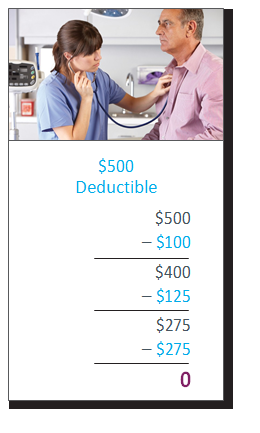 |
First Medical Visit John must pay $100 for x-rays. He still has $400 left in his deductible. Second Medical Visit John pays a $20 copay (this doesn’t apply to his deductible). Third Medical Visit John gets blood taken for tests and pays $125. Fourth Medical Visit John has an emergency and pays $275 at the ER. Deductible is now zero When John pays all of his deductible, certain services will now be covered at 100%. For example, if he has to get another x-ray he would not pay for it. |
Every plan is unique, so it’s crucial to examine all of the particulars.
Paying for your Health Insurance
Remember that health insurance is a contract that you sign with the health insurance company. The initial step is enrolling in health insurance, and the subsequent step is making the payment.
You will need to pay to have the entire amount of medical care or see a doctor if you need it, and if your health insurance is cancelled, you must also pay for it. Just like paying utilities and rent, it should now be a part of your monthly budget. In order to keep your insurance, you will need to pay a monthly insurance bill each month.
Upon your enrollment, the agreed-upon sum should align with the amount you are obligated to remit. Subsequently, a few days following your enrollment for health insurance via the Marketplace, you can anticipate receiving your inaugural bill from your newly selected insurer.
Reach out to your insurance provider, rather than the Marketplace, in case you have any queries regarding your insurance coverage in the days ahead, such as inquiries about expenses or your assigned physician. Seek assistance from a Navigator, CAC, or your insurance company without any hesitation.
Applying for Insurance
The Marketplace helps people who qualify for tax benefits, also known as subsidies, to find and purchase health insurance that is less expensive.
By yourself, either over the phone or online, you have the option to request health insurance via the Marketplace. In order to assist you in comprehending the options available to you, there are professionals who are specifically trained to aid you, such as Navigators or Certified Application Counselors (CACs), who collaborate with the Marketplace. They can assist you in submitting your application and determining the potential expenses, taking into account your income and the number of individuals in your family. Furthermore, they can address any inquiries you may have regarding the functioning and benefits of health insurance.
The Guide or CAC can assist you in completing the application, which typically takes approximately one hour. You will be required to bring various documents like salary records, tax filings, or immigration papers to your appointment. These records will aid in assessing your qualification for tax credits and determining your affordability for health insurance. The Marketplace application for health insurance will inquire about your expenditures, residency, family size, and income level.
Further Reading
Covering the Cost
The authors of this content are solely responsible for the provided contents, and the views expressed in this page do not necessarily represent HHS or any of its agencies. The content on this page was supported by Opportunity Funding Number CA-NAV-13-001 from the U.S. Department of Health and Human Services, Centers for Medicare & Medicaid Services.