One of the most common injuries among athletes who regularly engage in physically demanding exercises is a tear in the anterior cruciate ligament (ACL). The ACL tissues help prevent our knee from bending sideways during different movements.
Many patients with a torn ACL prefer to opt for orthobiologic treatments, which have a shorter and less painful recovery time. While some rely on alternatives and physical therapy, others prefer surgery. When the ACL is torn, the affected person feels immense knee pain during any extensive activity and pivoting or bending.
If you choose not to undergo surgery for your torn ACL, the long-term effects may include continuous pain and swelling. The surgical treatment for ACL involves restoring the ligament with tendon grafts.
What Are Non-Surgical ACL Tear Treatment Options?
This will help you restore a little balance in your daily activities, allowing you to perform them. Whether you opt for immediate surgery or delay it for rehabilitation, you must follow a certain procedure to reduce pain and prevent swelling.
Conventional Treatments
Here are some traditional non-surgical options for ACL tear treatment:
Orthobiologic Treatments
The field of regenerative medicine offers less painful and invasive alternatives to surgeries that tear the ACL. This field primarily includes orthobiologic treatments, such as plasma rich-platelet (PRP) therapies and cell-based treatments. Both of these treatment types involve reinjecting the patient’s own “autologous” tissues into the site of the injury to promote healing.
You can go home right after the BMAC and MMAT procedure, which takes about 2 hours, while the complete recovery and healing of the ACL tears is promoted by both regenerative therapies. PRP therapy takes approximately 45 minutes, whereas BMAC and MMAT procedures take around 1.5 hours. It is important to note that these procedures, PRP and Cell-based therapies, are considered outpatient treatments.
Is ACL Surgery Necessary After the Tear?
A clinical trial was conducted by B. Richard Frobell, a PhD physiotherapist at Lund University in Sweden, dividing 121 active young people, mostly highly competitive athletes, into two groups based on their treatment. Through this trial, his colleagues and Frobell himself found that surgery may not always be the first-hand treatment for ACL tears.
Both teams took part in a well-organized recovery program. They engaged in various exercises to enhance their knee stability and synchronization.
After a span of two years, both treatments demonstrated remarkable outcomes. Subsequently, both cohorts were reevaluated. The latter group delayed the surgical procedure until they genuinely required it or recuperated, whereas the initial group underwent ACL reconstruction surgery within a time frame of 10 weeks following the injury.
After sustaining an injury, it is not always imperative to undergo a surgical procedure. This implies that engaging in rehabilitation could potentially reduce the number of individuals requiring ACL surgery. Frobell’s findings indicated that 60% of patients who postponed ACL reconstruction surgery reported never requiring it. Nevertheless, a noteworthy distinction is that they ultimately never required the surgery.
Potential Long-Term Effects of No Surgery on the ACL Tear
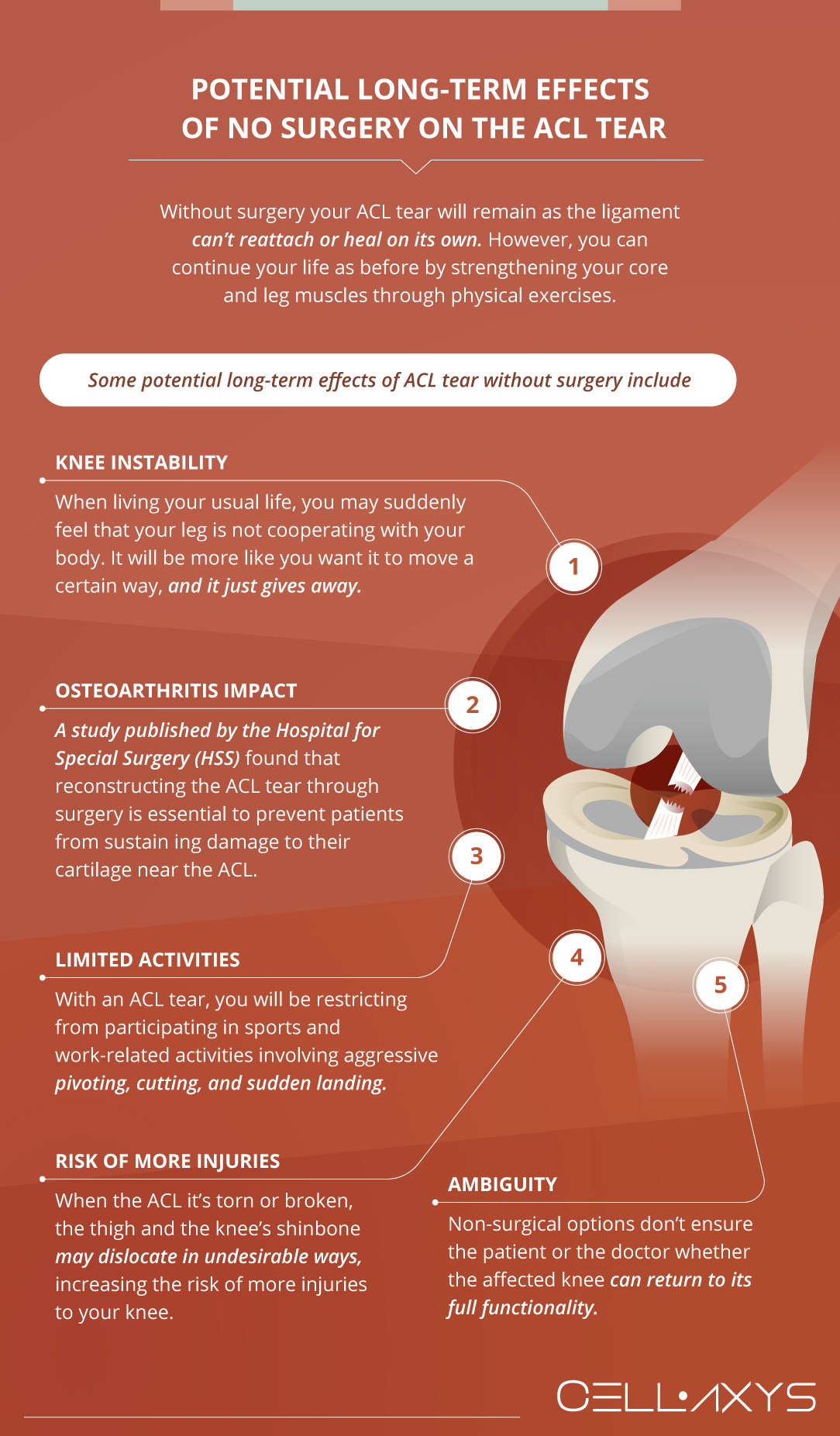
While surgery may not be your first choice, it is possible for your ACL tear to remain as the ligament cannot heal or reattach on its own. However, you can continue with your life before strengthening the leg and hip muscles through physical exercises, as your knee may heal on its own without experiencing swelling or pain. It is important to note that surgery can have potential side effects.
To preserve your body’s strength as an athlete or competitive sports player, it is important to take precautions to avoid injuries. Incorporating physically-challenging exercises into your daily regimen is highly recommended.
Surgery might be the best option for young individuals to fully enjoy their life. On the other hand, less active or older people can rely on non-surgical treatments to perform minimal daily activities.
Some possible long-term consequences of an ACL tear without undergoing surgery include:
In the foreseeable future, some sort of intervention will be necessary, but their ligament will remain torn, and numerous patients with ACL tears may not immediately encounter any of the aforementioned side effects.