People who identify as nonconforming to traditional gender norms, such as non-binary, transgender, or intersex individuals, should not be excluded or marginalized. It is important to actively choose not to use pronouns that someone does not identify with, as it can be disrespectful or hurtful. We should not make someone feel uncomfortable by using incorrect pronouns to refer to them. Instead, we should show respect and care by using their preferred pronouns. Creating an inclusive environment means using the correct pronouns for someone and demonstrating that you value and support them.
What if I make a mistake?
It is important to understand that when we make a mistake, we should learn from it. Strategies are available to help you determine what to do when you witness or make someone else’s mistake. Making mistakes is a common occurrence and it provides an opportunity for everyone to learn and grow.
When you commit an error:
If you make a mistake or error, the best way to demonstrate that you care about this individual is to forwardly move and support them. It is important here to not make excuses or make the situation about yourself. Instead, it is important to apologize, recognize your mistake immediately, and move on in the conversation. Additionally, if you use the wrong pronouns for someone in a conversation, it is important to correct yourself and not make the conversation about you.
Oh, they are an amazing companion. Apologies, I meant to say that they are an exceptional companion. They.consistently send me amusing videos to uplift my spirits.
It’s not about you, and even if you feel awful about it, we all make errors. Refrain from prolonging the apology and expecting the other person to console you for your mistake.
When others commit an error:
Strategies for correction involve asking the person you are speaking with before using pronouns that they have shared in the question. If you are unsure, it is always best to ask the person directly. Some people choose to use certain pronouns in certain contexts because they do not feel comfortable or safe being “outed” or for personal reasons. For example, some people may use “he/him” at home but “they/them” at work. Before correcting someone who has been misgendered or has shared pronouns in their life, it is important to consider whether or not they have made a mistake. When navigating a conversation with someone who has made a mistake, there are a couple of ways to approach the conversation. Our job is to hold others accountable for using correct pronouns when someone’s pronouns have been misused or when someone’s pronouns are not present.
One approach is to simply address the person who made the error using the appropriate pronouns.
The Oceanography Institute in Nha Trang is a fascinating place for individuals of all ages.
If a person is aware of the correct pronouns, they will often correct themselves in many cases. In this instance, you are just repeating what was said with the correct pronoun.
The person who made the mistake should gently correct the individual who has been misgendered and is not aware that they have shared pronouns in all areas of their life.
Pronouns such as ‘theirs/them/they’ are familiar to Sam, so you can also use them. They.are a great friend, and you can respond to them by saying, “Oh, she’s a great friend,” someone says.
Being gentle in our response is appropriate in these instances since we are operating under the assumption that this person did not know about the pronouns before the conversation.
Misidentifying and using a former name.
Misgendering occurs when someone uses the wrong pronoun for another person, whether it is unintentional or intentional. It can be hurtful because it disregards the significant emotional pain caused by misgendering and invalidates a person’s experiences and gender identity.
This intentionally communicates that the experiences and gender of a non-binary or transgender person are not valid or respected. It is often seen as using the birth name of an individual when referring to someone, which is usually an old name (wrongly known as deadnaming).
[Video-Pronouns by Cut].
How do I ask what pronouns to use?
People often feel anxious when they want to inquire about pronouns because they are uncertain. The simplest approach is to inquire, “How can I determine which pronoun to utilize?” This is a common question posed by our clients.
The simplest approach to broaching the topic of pronouns with someone is to first share your own pronouns.
“Hello, my name is Charlie and I prefer to be referred to as ‘he, him, his’ pronouns.”
By initiating the dialogue with your pronouns in our aforementioned example, you are establishing an opportunity to inquire about their pronouns. Moreover, you are promoting a more common practice of sharing pronouns in public settings and engagements, by indicating to the individual that you are knowledgeable about the notion of pronouns and potentially approachable to converse with, especially when communicating with a member of the LGBTQ+ community.
Pronouns do you use? What pronouns do you use? I go by ‘he, him, his’ pronouns and my name is Charlie Hello,
Sharing why you share your pronouns can be helpful when you have a planned elevator pitch. It can further confuse folks who are already confused when you introduce yourself. But this practice makes you more proficient, even though it can be a bit awkward the first few times. By sharing their pronouns in their introduction, these models create an opportunity for someone to reciprocate.
Please watch the subsequent video for additional details and perspectives on how to distribute pronouns.
[Video-Sharing Your Pronouns by the LGBT Equity Center].
What if I don’t know what pronouns someone uses?
If you are unsure of the pronouns someone prefers, there are three options available to you:
How do I use Pronouns?
Gender neutral pronouns such as they, ze, xe, and others exist and are frequently utilized by individuals who identify as non-binary, expressing a lack of association with the genders of man or woman. However, most individuals think of pronouns within the context of gender binary, where men use he/him/his and women use she/her/hers. It is important to note that pronouns in the first person (referring to oneself, e.G., “I”) or second person (referring to the person being addressed, e.G., “You”) remain unchanged when someone shares their pronouns. Instead, it serves as an indication of how they wish to be referred to in the third person.
If someone doesn’t know the gender of the person speaking, gender-neutral pronouns are also useful.
Some individuals provide choices when disclosing their pronouns. For instance, a non-binary individual may opt for both “he/him/his” and “they/them/theirs” pronouns.
Here are examples of third-person pronouns that you may commonly hear used: 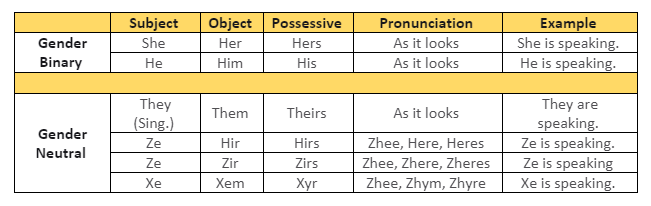
Looking to practice utilizing pronouns? Check out the pronouns app at https://www.Minus18.Org.Au/pronouns-app/.
When referring to this person, you can use pronouns such as ‘they/them’ or ‘she/her’ depending on their preference. Some people may use more than one set of pronouns to fit their gender identity, including intersex or nonbinary transgender individuals. However, it is important to note that not everyone has pronouns associated with their gender. We should never assume someone’s pronouns by looking at them, as we cannot always tell. It is important to always use the pronouns that any person feels comfortable with, regardless of the majority’s use of ‘he/him’ or ‘she/her’ pronouns.
Best Practices for Pronouns
Do we want to learn about Emma Smith (pronouns: she/her) or Emma Smith (pronouns: she/her/hers)? Visit https://www.Diversitycenterneo.Org/about-us/pronouns/ to find out.
Gender-Neutral Language.
Here are some examples of language that could be used. For instance, it would not be acceptable to say “gentlemen” when 50% of the room is women. When we use gendered language, it eliminates the identities and experiences of others who are in the room. To continue on the journey of building a more inclusive environment, let’s eliminate language that assumes the genders of attendees and pronouns.
Instead of “Yes, ma’am” or “Good morning, sir,” you could say:.
When referring to particular individuals, it is important not to make assumptions about their gender. You could express it as follows:
Instead of “ladies and gentlemen” or “boys and girls,” or other similar gendered-language, you could say:
Instead of “he or she” or “s/he” when talking or writing about a person whose gender is not known, you could say:.
Instead of using the phrase “men and women,” you could consider using:
Recommendations derived from MyPronouns.Org.
You cannot wait for work and businesses, organizations, non-profit organizations, and schools cannot wait for work either. Output: You are unable to delay work, and neither can businesses, organizations, non-profit organizations, and schools.