It may now make you wonder what is so special about effective communication skills, the most important thing we want to say is what we mean and mean what we say, but we don’t mean what we say, we mean what we mean.
The weight in your conversation usually comes from the belief in the idea. When you say whatever you mean, this automatically happens. It implies that you wholeheartedly believe in things you say.
You can’t get people to follow when you are pursuing a half-baked idea, no matter what you say. If you want people to believe in what you are saying, you need to start by having complete faith.
Conversely, despite the potential to upset others, these individuals generally remain unconcerned. Only a small minority of individuals worldwide embrace the practice of expressing their thoughts candidly, regardless of the circumstances.
In order to be a genuine communicator and achieve effectiveness, it is crucial to find the appropriate equilibrium between these two behaviors. These two types of behavior lie on opposite ends of the spectrum, and it is common for many individuals to choose the path of least resistance by avoiding conversations and prolonging the avoidance of certain topics.
Say What You Mean: 10 Quotes
Nothing compares to the insightful words of knowledgeable individuals to assist you in maintaining motivation in life. Here are a few quotations.
1. “You never know when a moment and a few sincere words can have an impact on a life.”
– Zig Ziglar
This quotation eloquently illustrates the significance of utilizing the appropriate language and positively impacting those in your vicinity.
2. “Who you are is speaking so loudly that I can’t hear what you are speaking.”
– Ralph Waldo Emerson
If you want people to hear what you are saying, it is important to have a pleasing personality. The way you communicate speaks volumes about your personality.
3. “When you start communicating to change people, you leave a lasting legacy. You profit from your impact, no in spite of it.”
– Dr. Michelle Mazur
Selecting words wisely ensures that your communication effectively conveys your ideas, influences individuals, and positively impacts the world around you.
4. “What will they think of me? Must be put aside for bliss.”
– Joseph Campbell
When you start a conversation, simply have faith in your thoughts and cease fretting about the opinions of others.
5. “Don’t be embarrassed by your failures. Learn from them and start again.”
– Sir Richard Branson
Every obstacle provides an opportunity to gain wisdom and improve oneself. Don’t allow setbacks to demoralize you. Instead, extract valuable lessons from them and move ahead.
6. “Wise men talk because they have something to say; fools, because they have to say something.”
– Plato
It is crucial to thoroughly assess the influence of your words before you actually express them.
7. “Emotional awareness is necessary so you can properly convey your thoughts and feelings to the other person.”
– Jason Goldberg
It is important to be emotionally aware of how your words can impact the lives of others around you and ensure that the words you use uplift and empower them.
8. “Communication sometimes is not what you first hear, listen not just to the words, but listen for the reason.”
– Catherine Pulsifer
Being a attentive listener is one of the initial stages to guaranteeing that you express what you intend.
9. “Replacing paper with a PC screen doesn’t change the need for clear, precise communication.”
– Kenneth Roman
In today’s technologically driven world, we extensively communicate through messages and emails, ensuring that the fundamental requirement for clear and precise communication remains unchanged.
10. “The single biggest problem in communication is the illusion that it has taken place.”
– George Bernard Shaw
To have a meaningful conversation, it is important to positively impact and clearly communicate every detail, ensuring that nothing is left to the other person’s assumptions.
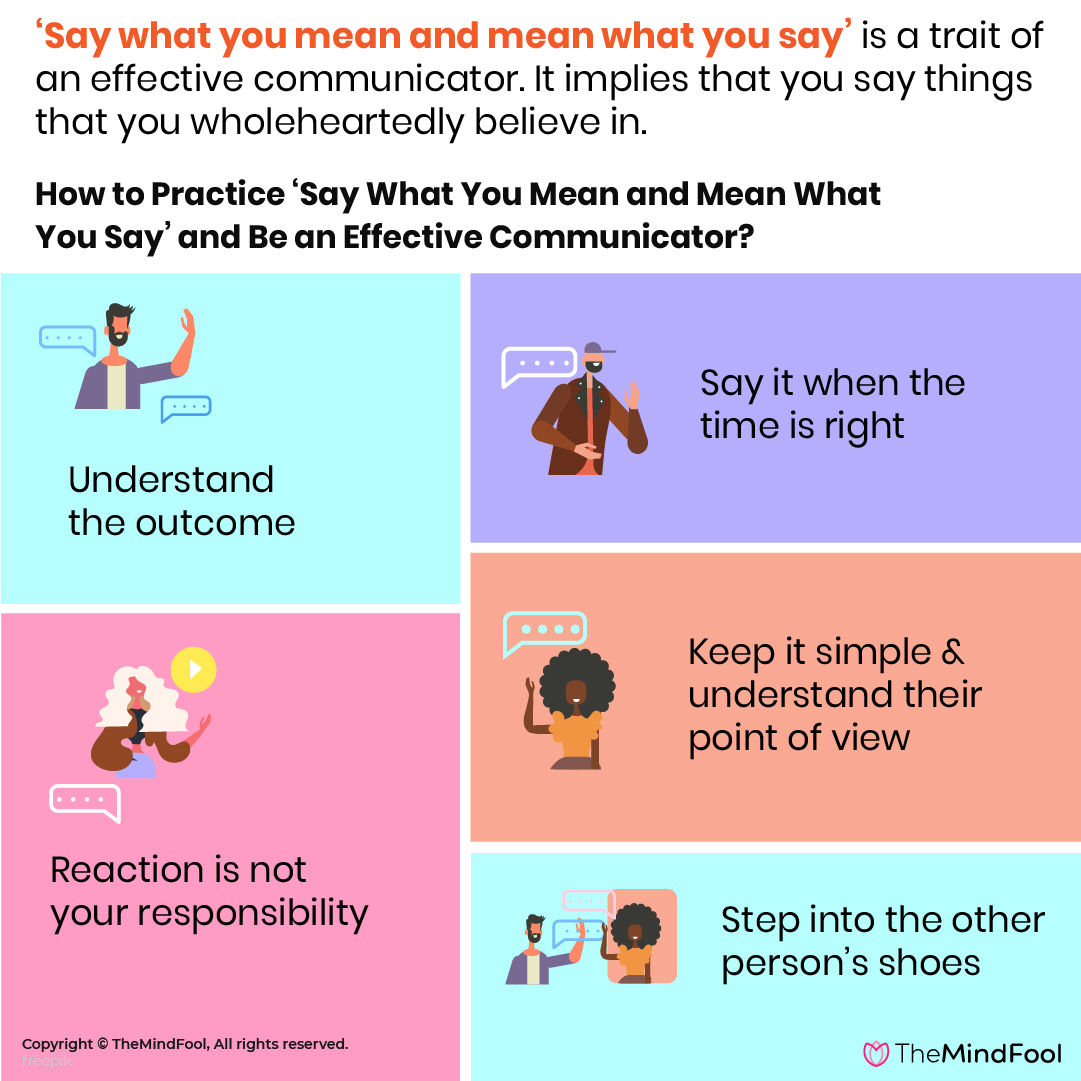
How to Practice ‘Say What You Mean and Mean What You Say’ and Be an Effective Communicator?
Express your thoughts honestly and sincerely. This will guarantee that your behaviors are backed by thorough assessment of the other individual’s words or actions. Hence, it is crucial to contemplate carefully before you communicate. Language holds immense influence in both personal and professional connections.
Seeing changes happen requires perseverance and effort. It is not easy to teach the mind. You will be surprised by the outcomes of your conversations once you start practicing. Even conversations that may seem unlikely to have positive outcomes can end up with a positive outcome. The words will have a greater impact.
Here are a few straightforward methods to become a proficient communicator by expressing your thoughts clearly and genuinely meaning what you articulate:.
1. Understand the outcome
Before deciding to enlighten people with your feedback, it is important for you to understand the outcome you expect and what you mean and say.
When you are seeking answers to these questions, you can decide the tone of your conversation. Do you want to just be aware of them or do you expect the other person to change their ways? Depending on the answers to these questions, you need to be clear in your head about the outcome you expect.
Be cautious that you may never be able to prioritize giving feedback to others on the other side of the conversation without trying to keep the same tone for all types of conversations.
2. Say it when the time is right
If the other person is not willing to hear it, you may not have a lot to say but the purpose will be defeated.
If you cannot ask for permission at least figure out the right time to do so. Ideally, you should seek the permission of the other person before sharing your inputs, hence it is important to be an effective communicator by considering what the other person is saying and how it impacts them.
3. Keep it simple
SUMMARY Remember that you are sharing feedback for one particular instance, so say what you have to by sticking to the facts.
Saying a lot of things before actually getting to the point is not uncommon, but it may be a bad idea to stick to the hardcore facts and keep it simple if you intend to mean what you say about beating around the bush.
It would be a good tip to handle the conversation in a way that subtly asks the person if they are interested in hearing more about how things could be handled differently, and then give your opinion.
4. The reaction is not your responsibility
SUMMARY When expressing your viewpoint, the other individual may or may not respond suitably.
Being an effective communicator means that you can only control your own actions. You cannot be responsible for the actions of others. Well, it is okay. You should not expect others to react as you would. When you share your views on someone’s actions, they may not react how you expect.
5. Step into the other person’s shoes
SUMMARY Just as you have something to express, others may also have a viewpoint to share.
Seek to comprehend their perspective and sincerely endeavor to empathize with them when providing feedback, remain receptive to comprehending the viewpoint of the other individual.
6. Mind your language
SummaryWhat we express holds significance. However, the manner in which we articulate it is equally critical.
It is equally important to support your conversation with confident and firm body language, in order to effectively convey what you mean. The way you carry yourself, including the confident shrug of your shoulders, the expressions on your face, and the subtle movements of your eyes, all play a crucial role in determining the impact of your conversation.
7. Be calm
SummaryStirring up never aided in demonstrating a point or persuading the other individual.
It may not be convincing that this speech is dangerous, because what you say can have an impact on your emotions, feelings, and thoughts. Often, when we are agitated, we bypass the process of evaluating or thinking. So if you intend to convey what you mean while staying calm, it can be a way of strongly conveying your message.
8. Choose words
Just like the mood of your dialogue, you must select your words cautiously.
Enhancing your lexicon and acquiring fresh vocabulary is a great approach to accomplish this. The terms that you select to articulate your ideas are concealed in the core of a fruitful dialogue.
9. Speak clearly
A great method to guarantee that your ideas are communicated effectively is to articulate clearly.
When communicating, pay attention to non-verbal signals. It is important not to be afraid of doing something good. Additionally, try to ask open-ended questions without being hesitant. It makes it easier for the other person to understand your ideas and improves clarity in conversations. You need to be clear about your speech and thoughts.
10. Control your emotions
SummaryYou must be at ease with your feelings in order to engage in a rational discussion.
Sound psychological well-being is vital for a productive dialogue. This also implies that your emotional aptitude will assist you in remaining engaged in the conversation’s subject matter. Be authentic and welcome the sentiments you encounter. In truth, when expressing oneself, refrain from suppressing your emotions.
11. Don’t be offensive
Summary: Don’t anticipate everyone to concur with what you express. Be courteous and acknowledge a divergence of viewpoint.
It is crucial to communicate while maintaining eye contact so that you can remember and acknowledge the people you are speaking to. Make sure that your views are framed in a manner that does not offend others around you. If necessary, reevaluate and consider the feedback you receive to ensure that you do not unintentionally offend anyone. When others express opinions that you do not agree with, it is important to respectfully disagree.
12. Learn from observation
SummaryTo speak sensibly, it is important to be attentive and observe the surroundings as they unfold.
If you are not observant, you may not notice the many things that can impact your conversation and the end of them. Remember, there are many things to remember if you intend to say what you mean and observe every detail around you.
13. Be organized
SummaryChaos never leads to a favorable conclusion. You need to organize your thoughts and be absolutely clear about when to say what.
You will intend precisely what you express and determine the appropriate moment to articulate the fitting vocabulary. Meticulously arrange your ideas to render it highly significant, hence significant discussions rely on your proficiency in articulating your intended message.
14. Show empathy
SummarySometimes the circumstances surrounding you may prompt you to alter the discussion. During such instances, you must be adaptable.
It is important to be an empathetic listener and to show a willingness to adapt to the meaningful conversation and the situation. It means that you say what you mean and mean what you say.
15. Be open and honest
SummaryDon’t confine your mind to your own viewpoint only. Keep it receptive.
In the grand scheme of things, effective communication holds great significance. To embrace feedback and consider others’ perspectives, it is crucial to cultivate an open mindset. Expressing your thoughts accurately enables you to maintain receptiveness.
Concluding note
Do you know what you mean and do you know what it means to be a master of art? It will require some amount of practice before you can become one. It is better to change this, as now it is considered rude to question or oppose the teacher. Remember, on the other side, try to be honest without hurting the person’s feelings. In most cases, we need to learn how to be honest without causing harm. Being honest is not an easy job.
We can say that all the effort you put in is worth it because it leads to results. However, it is important to keep in mind that we should not expect immediate outcomes. It takes time and consistent practice to see progress. Additionally, it is crucial to surround yourself with people who support and motivate you.